Sunday, June 5, 2011

Most Danger Animal In Asia

5. Mosquito

Mosquitoes are a vector agent that carries disease-causing viruses and parasites from person to person without catching the disease themselves.

The principal mosquito borne diseases are the viral diseases yellow fever, dengue fever and Chikungunya, transmitted mostly by the Aedes aegypti, and malaria carried by the genus Anopheles. Though originally a public health concern, HIV is now thought to be almost impossible for mosquitoes to transmit.

Mosquitoes are estimated to transmit disease to more than 700 million people annually in Africa, South America, Central America, Mexico, Russia and much of Asia with millions of resulting deaths. At least 2 million people annually die of these diseases.

Methods used to prevent the spread of disease, or to protect individuals in areas where disease is endemic include Vector control aimed at mosquito eradication, disease prevention, using prophylactic drugs and developing vaccines and prevention of mosquito bites, with insecticides, nets and repellents. Since most such diseases are carried by "elderly" females, scientists have suggested focusing on these to avoid the evolution of resistance.


4. Tiger

Tiger are territorial and generally solitary animals, often requiring large contiguous areas of habitat that support their prey demands. This, coupled with the fact that they are indigenous to some of the more densely populated places on earth, has caused significant conflicts with humans. Three of the nine subspecies of modern tiger have gone extinct, and the remaining six are classified as endangered, some critically so. The primary direct causes are habitat destruction, fragmentation, and hunting

3. Malayan Pit Viper
This species has a reputation for being bad-tempered and quick to strike. In northern Malaysia it is responsible for some 700 incidents of snakebite annually with a mortality rate of about 2 percent. Remarkably sedentary, it has often been found in the same spot several hours after an incident involving humans. Its venom causes severe pain and local swelling and sometimes tissue necrosis, but deaths are extremely rare.

2. Camel Spider

The most distinctive feature of Solifugae is their large chelicerae, which are longer than the prosoma. Each of the two chelicerae are composed of two articles forming a powerful pincer; each article bears a variable number of teeth.

While solifuges appear to have ten legs, they have eight legs like other arachnids; the first set of appendages are pedipalps, which function as sense organs similar to insects' antennae and give the appearance of an extra pair of legs. The pedipalps terminate in eversible adhesive organs, which are used to capture flying prey, and for climbing. They stridulate with their chelicerae, resulting in a rattling noise.

Of the four pairs of legs, the first pair are smaller in size, and act as accessory tactile organs used to feel the animal's surroundings, so that only the other six legs are used for running. On the last pair of legs, Solifugae have fan-shaped sensory organs called racquet organs or malleoli.
Like pseudoscorpions and harvestmen, they lack book lungs, having instead a well-developed tracheal system that takes in air through three pairs of slits on the animal's underside. In some species there are very large central eyes that are capable of recognising forms, and are used for hunting. Lateral eyes are only rudimentary, if present at all. Males are usually smaller than females, with longer legs.


1. Krait

Bungarus species have highly potent neurotoxic venom which can induce muscle paralysis. Clinically, their venom contains mostly pre-synaptic neurotoxins. These affect the ability of neuron endings to properly release the chemical that sends the message to the next neuron. Following envenomation with bungarotoxins, transmitter release is initially blocked (leading to a brief paralysis), followed by a period of massive overexcitation (cramps, tremors, spasms), which finally tails off to paralysis. These phases may not be seen in all parts of the body at the same time. Since kraits are nocturnal they seldom encounter humans during daylight hours, so bites are rare and they may prefer to deliver non-fatal bites, but a bite from a krait is potentially life-threatening, and should be regarded as a medical emergency.

Typically, victims start to complain later of severe abdominal cramps accompanied by progressive muscular paralysis, frequently starting with ptosis. As there are no local symptoms, a patient should be carefully observed for tell-tale signs of paralysis (e.g. the onset of ptosis, diplopia and dysphagia) and treated urgently with antivenom. Prior to the availability of the antivenom,the mortality rate among the victims bitten can be high (the rate is various among different species). There is frequently little or no pain at the site of a krait bite, which can provide false reassurance to the victim. Several websites state the statement that there is a mortality rate of 50% even with treatment, but there is no original source in the medical literature for this statement. The major medical difficulty of patients envenomated are the lack of medical resources (especially intubation supplies and mechanical ventilators in rural hospitals) and the ineffectiveness of the antivenom. Definitive care may also be delayed as patients may first visit the local mantrik or tantrik, a holy person and traditional healer who may attempt to rid the body of the venom with spells or herbal remedies, which are ineffective interventions

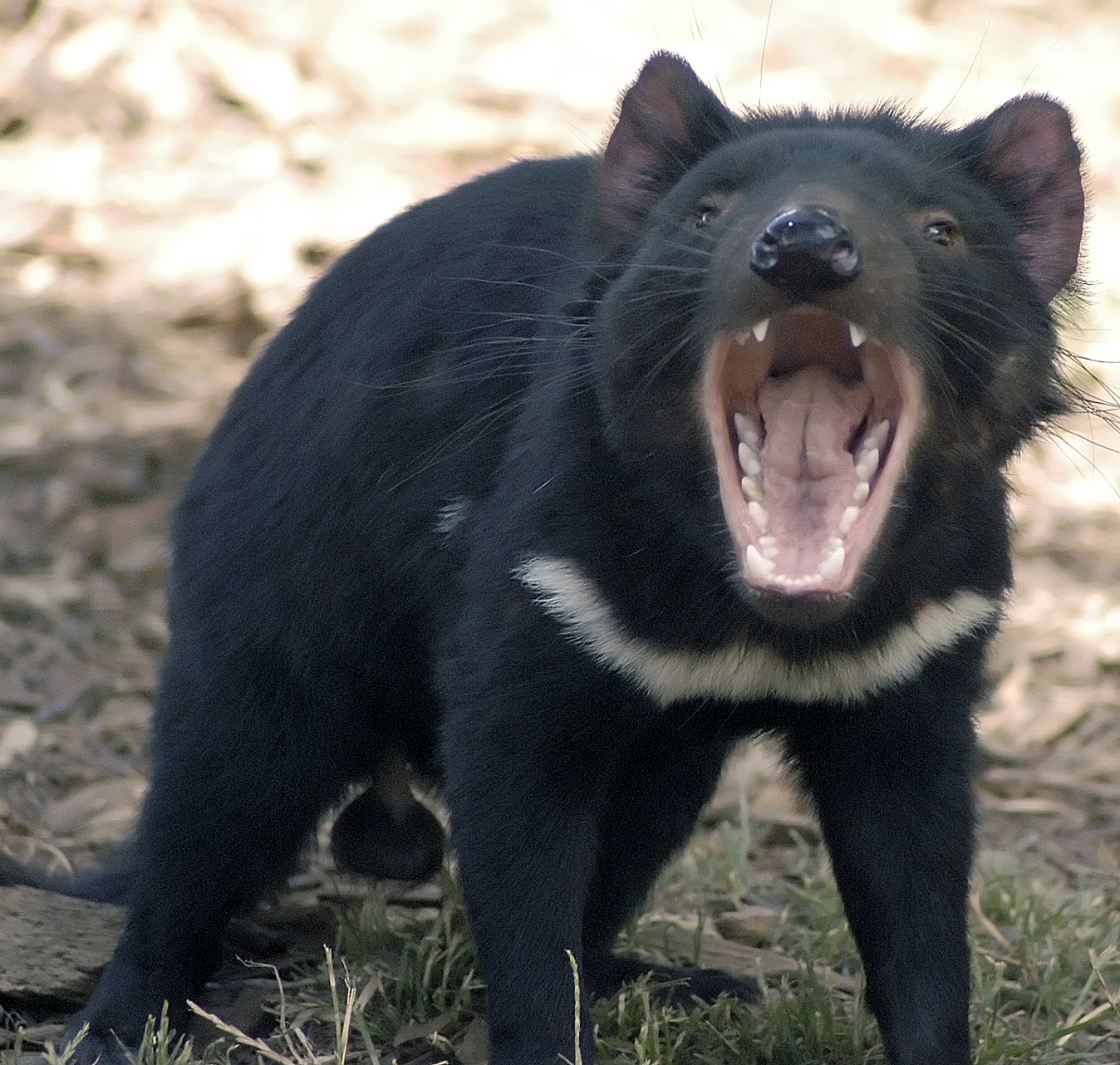
Tasmanian Devil


The Tasmanian devil (Sarcophilus harrisii) is a carnivorous marsupial of the family Dasyuridae now found in the wild only in the Australian island state of Tasmania. The size of a small dog, it became the largest carnivorous marsupial in the world following the extinction of the thylacine in 1936. It is characterised by its stocky and muscular build, black fur, pungent odour, extremely loud and disturbing screech, keen sense of smell, and ferocity when feeding. The Tasmanian devil's large head and neck allow it to generate the strongest bite per unit body mass of any living mammal, and it hunts prey and scavenges carrion as well as eating household products if humans are living nearby. Although it is usually solitary, it sometimes eats with other devils and defecates in a communal location. Unlike most other dasyurids, the devil is able to thermoregulate effectively and is active during the middle of the day without overheating. Despite its rotund appearance, the devil is capable of surprising speed and endurance, and can climb trees and swim across rivers.

It is believed that ancient marsupials migrated to Australia tens of millions of years ago during the time of Gondwana, from what is now South America, and that they evolved as Australia became more arid. Fossils of species similar to modern devils have been found, but it is not known whether they were the ancestors of the contemporary species, or whether the current devils were co-existing species that have now died out. The date that the Tasmanian devil disappeared from the Australian mainland is unclear; most evidence suggests they had contracted to three relict populations around 3000 years ago, however a tooth found in Augusta, Western Australia has been dated to 430 years ago. Archaeologist Oliver Brown disputes this and considers the devil's mainland extinction to have occurred around 3000 years ago. This disappearance is usually blamed on dingoes, which are absent from Tasmania. Because they were seen as a threat to livestock and animals that humans targeted for fur in Tasmania, devils were hunted and became endangered. In 1941, the devils, which were originally seen as implacably vicious, became officially protected. Since then, scientists have contended that earlier concerns that the devils were the most significant threat to livestock were overestimated and misplaced.

Devils are not monogamous, and the reproductive process is very robust and competitive. Males fight one another for the females, and then guard their partners to prevent female infidelity. Females can ovulate three times in as many weeks during the mating season, and 80% of two-year-old females are seen to be pregnant. Females average four breeding seasons in their life and give birth to 20–30 live young after three weeks. The newborn are pink, lack fur, and have indistinct facial features, and they weigh around 0.20 g (0.0071 oz) at birth. As there are only four nipples in the pouch, competition is fierce and few newborns survive. The young grow rapidly and are ejected from the pouch after around 100 days, weighing roughly 200 g (7.1 oz). The children become independent after around nine months, so the female spends most of her year in activities related to childbirth and rearing.

Tuesday, March 8, 2011

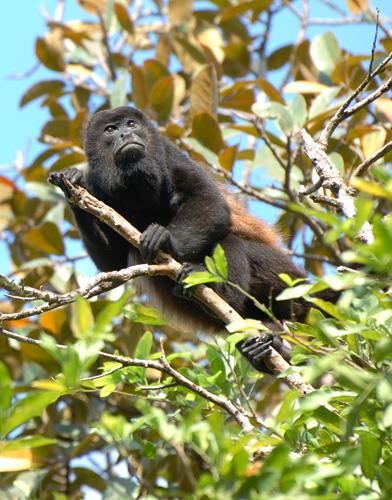
Howler monkey

Male howler monkey

Howler monkeys have a short snout, and wide-set, round nostrils. They range in size from 56 to 92 cm, excluding their tail which can be equally as long. Like many New World monkeys, they have prehensile tails. Unlike other New World monkeys, both male and female howler monkeys have trichromatic color vision.[2] This has evolved independently from other New World monkeys due to gene duplication.[3] They have a lifespan of 15 to 20 years. Howler species are dimorphic and can also be dichromatic (i.e. Alouatta caraya). Males are, on average, 1.5 to 2 kg heavier than females.

The hyoid of Alouatta is pneumatized -- one of the few cases of postcranial pneumaticity outside Saurischia.
Locomotion
Howler monkeys generally move quadrupedally on the tops of branches, usually grasping a branch with at least two hands or one hand and the tail at all times. They have strong prehensile tails which are able to support the monkey's entire body weight. However, fully adult howler monkeys do not often rely on their tail for full body support whereas juveniles do so more frequently.

Communication

As their name suggests, vocal communication forms an important part of their social behavior. They have an enlarged basihyal or hyoid bone which helps them make their loud vocalizations. Group males generally call at dawn and dusk as well as interspersed times throughout the day. The main vocals consist of loud, deep guttural growls or "howls." Howler monkeys are widely considered to be the loudest land animal. According to Guinness Book of World Records, their vocalizations can be heard clearly for 3 miles (4.8 km). It is hypothesized that the function of howling relates to intergroup spacing and territory protection, as well as possibly mate-guarding.
 
Diet and feeding
These large and slow moving monkeys are the only folivores of the New World monkeys. Howlers eat mainly top canopy leaves, together with fruit, buds, flowers, and nuts. They need to be careful not to eat too much of certain species of mature leaf in one sitting, as some of the leaves they eat contain toxins that can poison the monkey.[6] Howler monkeys are also known to occasionally raid birds nests and chicken coops and consume the eggs

Relationship with human
While seldom aggressive, howler monkeys do not take well to captivity and are of surly disposition, and hence are the only monkey in their forests not made a pet by the Native Americans[citation needed]. However, the Black Howler (Alouatta caraya) is a relatively common pet monkey in contemporary Argentina due to its gentle nature, in comparison to the capuchin monkey's aggressive tendencies, in spite of its lesser intelligence as well as the liabilities meant by the size of its droppings and the males' loud vocalisation.

Alexander von Humboldt said about howler monkeys that "their eyes, voice, and gait are indicative of melancholy", while John Lloyd Stephens described those at the Maya ruins of Copán as "grave and solemn as if officiating as the guardians of consecrated ground". To the Mayas of the Classic Period, they were the divine patrons of the artisans, especially scribes and sculptors. Copán in particular is famous for its representations of Howler Monkey Gods. Two howler monkey brothers play a role in the 16th century myth of the Maya Hero Twins included in the Popol Vuh.

Sunday, February 6, 2011

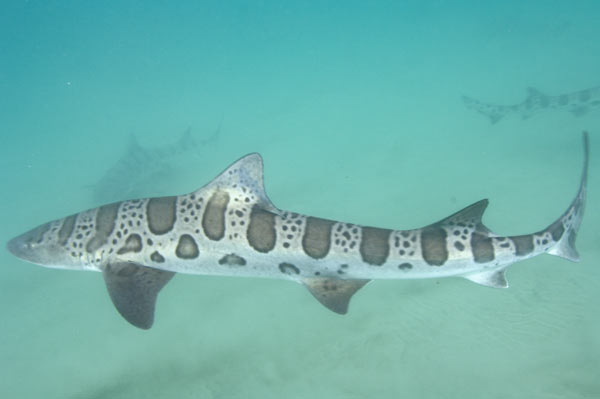
Leopard shark

Identification:

Easily distinguished by bold pattern of large dark saddles extending from the head along the back. Centre of saddles lighter in adults. Saddles are separated by smaller dark spots on a cream to grey/brown background. Overall body shape is elogated and slender. Second dorsal proportionately large. Pectoral fins falcate. Snout broadly rounded with widely spaced nasal flaps that do not reach mouth.

Albino Leopard sharks have rare but have been recorded.


Size:

Maximum recorded size 180cm. Size at birth 20cm.


Habitat:

Prefers shallow sand flats and confined muddy bays. Likes turbid water. Occasionally in or near kelp beds on rocky substrate.


Abundance and distribution:

Confined to the temperate and tropical coastline between Oregon and Southern Baja including the Sea of Cortez. Often seen in large aggregations close to shore. Usually intertidal to 4m but has been recorded as deep as 91m.

 
It is usually possible to find Leopard Sharks throughout the summer and early fall directly in front of the Marine Room Restaurant in La Jolla. Why the sharks like this spot isn't clear but it may simply be that they patrol the entire coastline and this is where the snorkellers enter the water to see them.

A good way to get closer to the sharks is to carry some fish but note that La Jolla is a protected area and feeding or harassing the marine life within the park is illegal.


Other diving locations submitted by readers:

Ron Clough (Organizer of the California Shark and Ray Count) suggests that any places where warmer than normal water flows into the sea (e.g. from power plants) Leopard Sharks are likely to be seen


Lion fish

            This brightly colored and graceful fish is usually found in coral reefs, especially in shallow waters of the Indo-Pacific region, hovering in caves. The lion-fish belongs to the Scorpion fish family and are venomous. They move incredible fast in order to catch its prey. What part of its body delivers the venom? The spines. The colorful lion fish have long fin spines that can produce painful puncture wounds. A person punctured by one of the sharp spines will immediately feel severe pain and swelling. The sting is rarely fatal and wound may take several months to fully heal.


Give food to fishes

Dog